Why TRL alone should not dictate readiness for company formation

If you run a tech transfer office, you have a reliable way to talk about how far a technology has come. In federally funded research, that shorthand is often the Technology Readiness Level (TRL). A TRL of 6 means something specific, it tells people how far the science has matured toward leaving the lab, and it gives you a clean way to report that progress to funders and partners.
That clarity is also the problem. TRL is the one part of readiness with a simple numeric representation, so it ends up describing whole portfolios and reporting progress across a program. Everything else that makes a company (the market, the team, the IP, the business model) is harder to summarize, so it is communicated as judgment rather than a score. Over time, technical readiness has stood in for company readiness. A strong TRL makes it feel like the company is already taking shape, when all it really tells you is that the science is.
Deciding whether a technology should become a company begs questions a TRL was never meant to answer:
- Is there a buyer who feels the pain, or just an interesting problem?
- Is there a product someone would pay for, or only a capability?
- Is the founder on the way to building the right team?
- Is there a plan to build a protective moat around the IP?
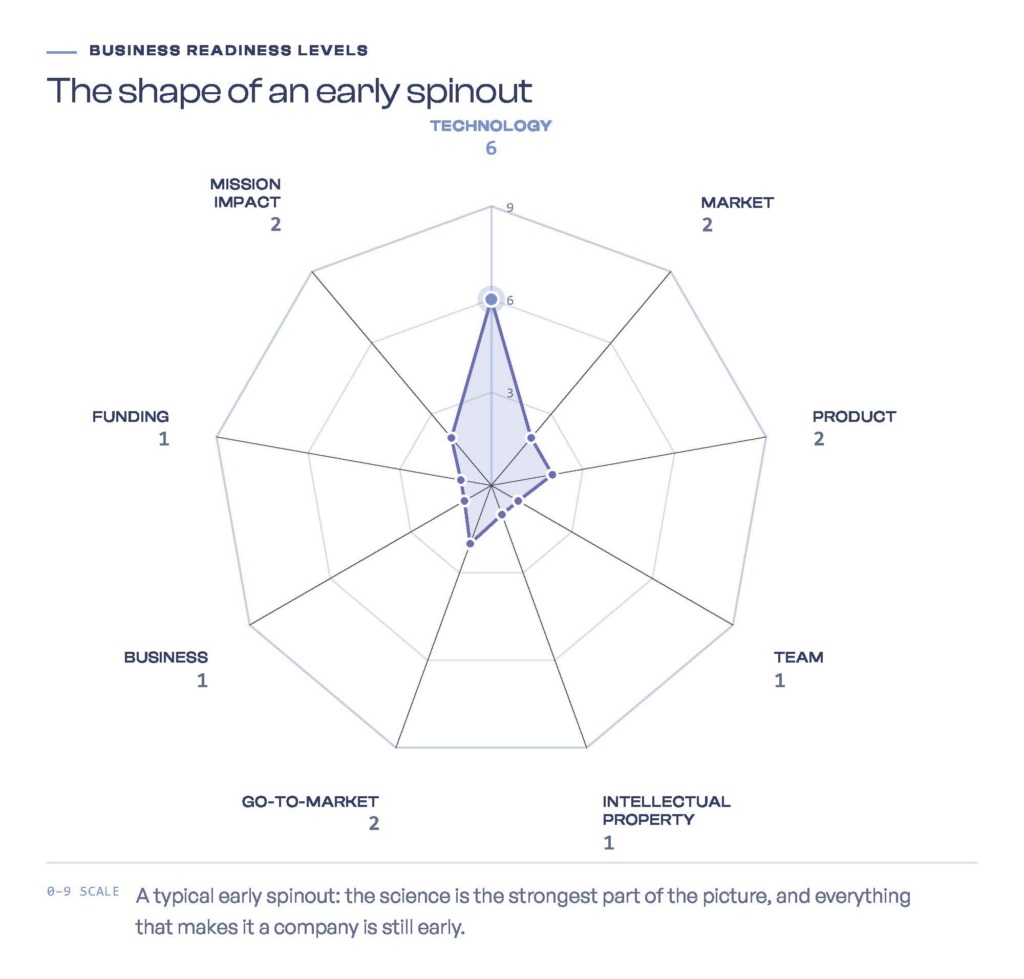
Teams already weigh these questions. What they lack is a common way to score and communicate them, the way TRL does for the technology.
That is the gap the Business Readiness Levels close. BRLs track how far a venture has progressed and how much of its risk has been retired across the dimensions that decide whether it can become a company. They don’t predict whether a startup will succeed, they show whether it is moving in the right direction and clearing the milestones that matter.
BRLs assess nine dimensions, each scored from zero to nine: Technology, Market, Product, Team, Intellectual Property, Go-to-Market, Business, Funding, and Mission Impact. The Technology dimension is TRL, used exactly as defined originally by NASA.
The value is a shared starting line. You can’t set a development goal for a venture until you know where it stands, and you can’t communicate that clearly by looking at the technology alone. “This one needs work” becomes “this is a Technology 6 and a Market 2, and the next move is customer discovery.”
Take a project we worked on with Dr. Ryan Mehl at Oregon State University. His lab had pioneered genetic code expansion, a robust technology for making precise protein modifications, with applications across drug development, protein labeling, and diagnostics. The science was easily the strongest part of the picture, and building a company around it looked like the obvious next step. The catch was that a capable technology said nothing about which of those applications was a business.
Scoring the project across all nine dimensions gave us a roadmap. Market and customer discovery narrowed a long list of possibilities to a single beachhead, and the IP strategy was built around that specific use rather than the technology in general. Just as important, the baseline gave us a clear way to talk about progress and to tell the story to NSF.
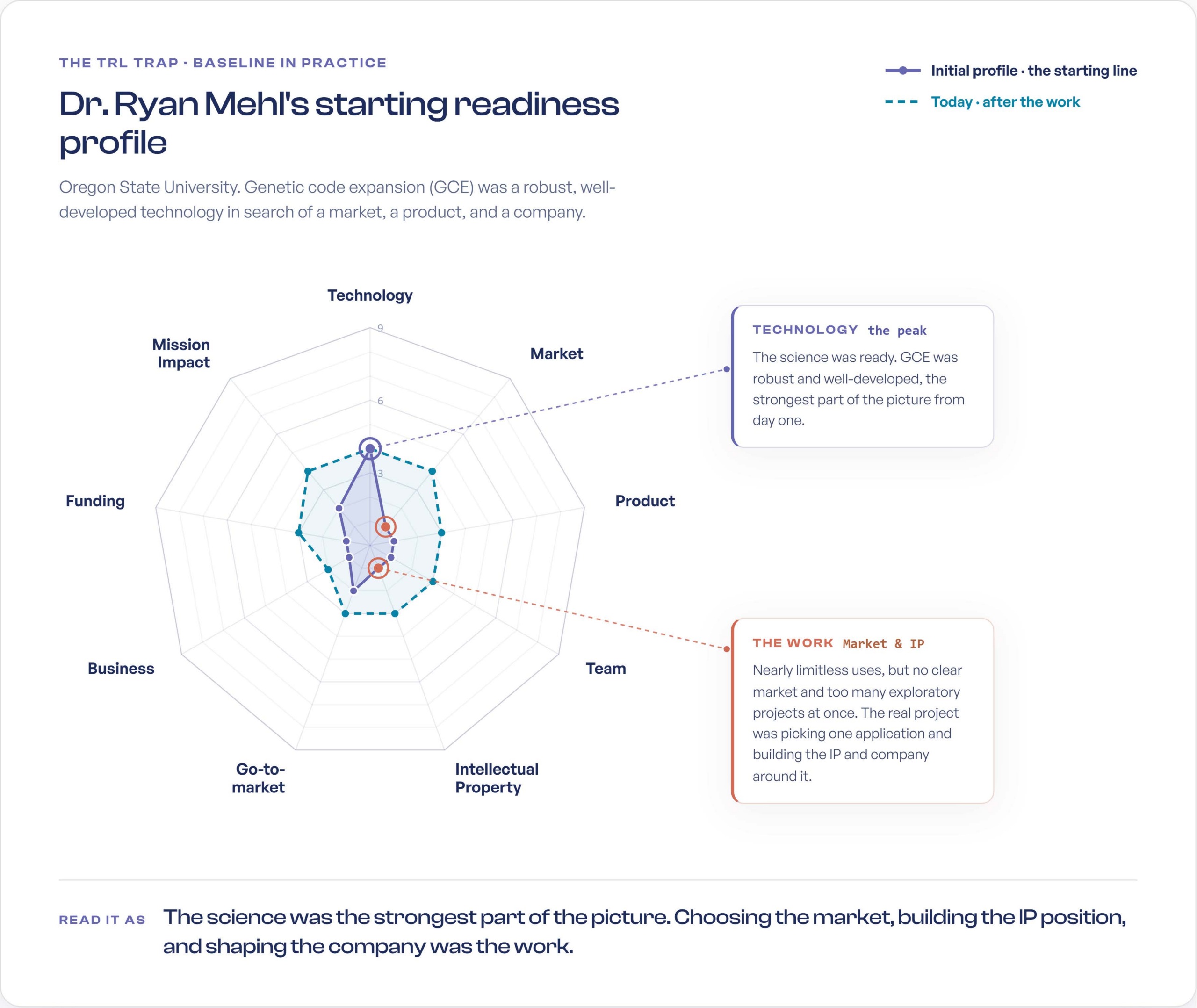 Neither the choice of market nor the shape of the IP would have shown up on a TRL, and both were what stood between a strong technology and a company with the potential for commercial traction.
BRLs aren’t a gate a venture has to clear before you’ll work with it, and the score itself isn’t the point. They give you and your founder a shared picture of where the venture stands and what to fix next, so you spend less time talking past each other. A low score isn’t a failure; it marks the next piece of work. Whether the venture is a therapeutic, a sensor, or a software tool, the categories stay the same while the evidence you’d expect in each depends on the venture.
TRL made company readiness easy to overlook by making technology readiness so easy to see. BRLs make the rest of the picture just as visible.
The framework came out of real venture work. To see the full set of categories and how each level is defined, you can request the Business Readiness Levels.